Encyclopãƒâ©die Ou Dictionnaire Raisonnãƒâ© Des Sciences Des Arts Et Des Mãƒâ©tiers Vol 15
 The title page of the Encyclopédie | |
| Author | Numerous contributors, edited by Denis Diderot and Jean le Rond d'Alembert |
|---|---|
| Land | France |
| Linguistic communication | French |
| Subject | General |
| Genre | Reference encyclopedia |
| Publisher | André le Breton, Michel-Antoine David, Laurent Durand and Antoine-Claude Briasson |
| Publication date | 1751–1766 |
Encyclopédie, ou dictionnaire raisonné des sciences, des arts et des métiers (English: Encyclopedia, or a Systematic Dictionary of the Sciences, Arts, and Crafts),[1] better known as Encyclopédie , was a general encyclopedia published in France between 1751 and 1772, with subsequently supplements, revised editions, and translations. It had many writers, known equally the Encyclopédistes. It was edited by Denis Diderot and, until 1759, co-edited by Jean le Rond d'Alembert.[ii]
The Encyclopédie is most famous for representing the thought of the Enlightenment. According to Denis Diderot in the article "Encyclopédie", the Encyclopédie's aim was "to change the manner people think" and for people (suburbia) to exist able to inform themselves and to know things.[3] He and the other contributors advocated for the secularization of learning away from the Jesuits.[iv] Diderot wanted to incorporate all of the world'southward cognition into the Encyclopédie and hoped that the text could disseminate all this data to the public and future generations.[5]
It was also the first encyclopedia to include contributions from many named contributors, and it was the first full general encyclopedia to draw the mechanical arts. In the first publication, seventeen folio volumes were accompanied past detailed engravings. Later volumes were published without the engravings, in guild to better attain a wide audience within Europe.[6]
Origins [edit]
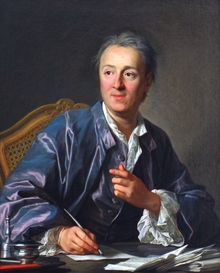
The Encyclopédie was originally conceived equally a French translation of Ephraim Chambers's Cyclopaedia (1728).[vii] Ephraim Chambers had first published his Cyclopaedia, or an Universal Dictionary of Arts and Sciences in two volumes in London in 1728, following several dictionaries of arts and sciences that had emerged in Europe since the late 17th century.[viii] [9] This work became quite renowned, and four editions were published between 1738 and 1742. An Italian translation appeared between 1747 and 1754. In France a member of the banking family Lambert had started translating Chambers into French,[x] just in 1745 the expatriate Englishman John Mills and German Gottfried Sellius were the commencement to actually prepare a French edition of Ephraim Chambers's Cyclopaedia for publication, which they entitled Encyclopédie.
Early in 1745 a prospectus for the Encyclopédie [11] was published to concenter subscribers to the projection. This 4 folio prospectus was illustrated past Jean-Michel Papillon,[12] and accompanied past a plan, stating that the work would be published in five volumes from June 1746 until the end of 1748.[thirteen] The text was translated by Mills and Sellius, and it was corrected by an unnamed person, who appears to have been Denis Diderot.[14]
The prospectus was reviewed quite positively and cited at some length in several journals.[15] The Mémoires pour fifty'histoire des sciences et des beaux arts journal was lavish in its praise: "voici deux des plus fortes entreprises de Littérature qu'on ait faites depuis long-temps" (here are two of the greatest efforts undertaken in literature in a very long time).[xvi] The Mercure Journal in June 1745, printed a 25-page article that specifically praised Mills' role as translator; the Periodical introduced Mills as an English language scholar who had been raised in France and who spoke both French and English as a native. The Journal reported that Mills had discussed the piece of work with several academics, was zealous about the project, had devoted his fortune to support this enterprise, and was the sole owner of the publishing privilege.[17]
However, the cooperation savage autonomously afterward on in 1745. André le Breton, the publisher commissioned to manage the physical production and sales of the volumes, cheated Mills out of the subscription money, challenge for instance that Mills'south knowledge of French was inadequate. In a confrontation Le Breton physically assaulted Mills. Mills took Le Breton to courtroom, merely the court decided in Le Breton'due south favour. Mills returned to England soon after the court'south ruling.[18] [xix] For his new editor, Le Breton settled on the mathematician Jean Paul de Gua de Malves. Amidst those hired past Malves were the immature Étienne Bonnot de Condillac, Jean le Rond d'Alembert, and Denis Diderot. Within 13 months, in August 1747, Gua de Malves was fired for being an ineffective leader. Le Breton then hired Diderot and d'Alembert to be the new editors.[20] Diderot would remain equally editor for the side by side twenty-five years, seeing the Encyclopédie through to its completion; d'Alembert would leave this role in 1758. As d'Alembert worked on the Encyclopédie, its title expanded. As of 1750, the full title was Encyclopédie, ou Dictionnaire raisonné des sciences, des arts et des métiers, par une société de gens de lettres, mis en ordre par Yard. Diderot de l'Académie des Sciences et Belles-Lettres de Prusse, et quant à la partie mathématique, par M. d'Alembert de l'Académie royale des Sciences de Paris, de celle de Prusse et de la Société royale de Londres. ("Encyclopedia: or a Systematic Dictionary of the Sciences, Arts, and Crafts, by a Visitor of Persons of Messages, edited by Grand. Diderot of the University of Sciences and Belles-lettres of Prussia: as to the Mathematical Portion, arranged by Yard. d'Alembert of the Royal Academy of Sciences of Paris, of the Academy of Sciences in Prussia and of the Royal Club of London.") The title page was amended equally d'Alembert acquired more titles.
Publication [edit]

Extract from the frontispiece of the Encyclopédie (1772). It was drawn past Charles-Nicolas Cochin and engraved past Bonaventure-Louis Prévost. The work is laden with symbolism: The figure in the centre represents truth—surrounded by bright light (the central symbol of the Enlightenment). Two other figures on the right, reason and philosophy, are tearing the veil from truth.
The work consisted of 28 volumes, with 71,818 articles and iii,129 illustrations.[21] The offset seventeen volumes were published between 1751 and 1765; 11 volumes of plates were finished by 1772. Engraver Robert Bénard provided at least 1,800 plates for the work. The Encyclopédie sold 4,000 copies during its commencement twenty years of publication and earned a profit of 2 million livres for its investors.[22] Because of its occasional radical contents (meet "Contents" beneath), the Encyclopédie caused much controversy in bourgeois circles, and on the initiative of the Parlement of Paris, the French authorities suspended the encyclopedia'south privilège in 1759.[23] Interestingly enough, the Encyclopédie had also been banned 1752 after publication of the second volume.[24] Despite these issues, work continued "in secret," partially because the project had highly placed supporters, such every bit Malesherbes and Madame de Pompadour.[25] The government deliberately ignored the continued work; they thought their official ban was sufficient to appease the church and other enemies of the project.
During the "secretive" catamenia, Diderot accomplished a well-known work of subterfuge. The title pages of volumes i through 7, published between 1751 and 1757, claimed Paris equally the place of publication. Notwithstanding, the championship pages of the subsequent text volumes, 8 through 17, published together in 1765, testify Neufchastel equally the identify of publication. Neuchâtel is safely across the French border in what is now office of Switzerland but which was then an independent principality,[26] where official production of the Encyclopédie was secure from interference by agents of the French state. In particular, regime opponents of the Encyclopédie could not seize the production plates for the Encyclopédie in Paris considering those press plates ostensibly existed only in Switzerland. Meanwhile, the actual production of volumes 8 through 17 quietly continued in Paris.
In 1775, Charles Joseph Panckoucke obtained the rights to reissue the work. He issued five volumes of supplementary cloth and a two-volume index from 1776 to 1780. Some scholars include these 7 "extra" volumes as office of the first full issue of the Encyclopédie, for a total of 35 volumes, although they were not written or edited by the original authors.
From 1782 to 1832, Panckoucke and his successors published an expanded edition of the work in some 166 volumes as the Encyclopédie Méthodique. That piece of work, enormous for its time, occupied a thousand workers in production and ii,250 contributors.
Contributors [edit]
Since the objective of the editors of the Encyclopédie was to gather all the knowledge in the world, Diderot and D'Alembert knew they would need various contributors to assist them with their project.[27] Many of the philosophes (intellectuals of the French Enlightenment) contributed to the Encyclopédie, including Diderot himself, Voltaire, Rousseau, and Montesquieu.[7] The near prolific contributor was Louis de Jaucourt, who wrote 17,266 articles between 1759 and 1765, or about eight per day, representing a full 25% of the Encyclopédie. The publication became a place where these contributors could share their ideas and interests.
Withal, every bit Frank Kafker has argued, the Encyclopedists were non a unified group:[28]
... despite their reputation, [the Encyclopedists] were non a close-knit group of radicals intent on subverting the One-time Regime in France. Instead they were a disparate group of men of letters, physicians, scientists, craftsmen and scholars ... even the small minority who were persecuted for writing articles belittling what they viewed as unreasonable customs—thus weakening the might of the Cosmic Church and undermining that of the monarchy—did not envision that their ideas would encourage a revolution.
Post-obit is a listing of notable contributors with their area of contribution (for a more detailed list, run into Encyclopédistes):
- Jean Le Rond d'Alembert – editor; science (specially mathematics), contemporary affairs, philosophy, religion, among others
- Claude Bourgelat – manège, farriery
- André le Breton – principal publisher; article on printer's ink
- Louis-Jean-Marie Daubenton – natural history
- Denis Diderot – chief editor; economics, mechanical arts, philosophy, politics, faith, among others
- Baron d'Holbach – science (chemistry, mineralogy), politics, religion, amidst others
- Chevalier Louis de Jaucourt – economic science, literature, medicine, politics, bookbinding, among others
- Jean-Baptiste de La Chapelle – mathematics
- Abbé André Morellet – theology, philosophy
- Montesquieu – part of the article "Goût" ("Gustation")
- François Quesnay – articles on revenue enhancement farmers and grain
- Jean-Jacques Rousseau – music, political theory
- Anne Robert Jacques Turgot, Baron de Laune – economics, etymology, philosophy, physics
- Voltaire – history, literature, philosophy
Due to the controversial nature of some of the articles, several of its editors were sent to jail.[29]
Contents and controversies [edit]
Construction [edit]
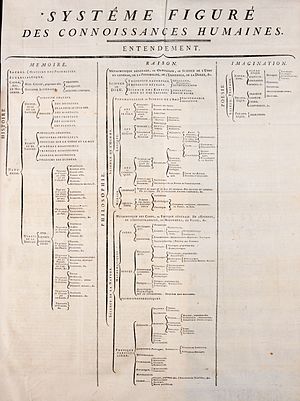
Similar well-nigh encyclopedias, the Encyclopédie attempted to collect and summarize human knowledge in a variety of fields and topics, ranging from philosophy to theology to scientific discipline and the arts. The Encyclopédie was controversial for reorganizing noesis based on homo reason instead of by nature or theology.[30] Knowledge and intellect branched from the three categories of man thought, whereas all other perceived aspects of cognition, including theology, were simply branches or components of these man-fabricated categories.[31] The introduction to the Encyclopédie, D'Alembert'south "Preliminary Discourse", is considered an important exposition of Enlightenment ideals.
Religious and political controversies [edit]
They harshly criticized superstition as an intellectual error in his article on the topic.[32] They therefore doubted the authenticity of presupposed historical events cited in the Bible and questioned the validity of miracles and the Resurrection.[33] Nevertheless, some contemporary scholars argue the skeptical view of miracles in the Encyclopédie may exist interpreted in terms of "Protestant debates about the cessation of the charismata."[34]
These challenges led to suppression from church and state authorities. The Encyclopédie and its contributors endured many attacks and attempts at censorship past the clergy or other censors, which threatened the publication of the project as well as the authors themselves. The King's Council suppressed the Encyclopédie in 1759.[35] The Catholic Church, under Pope Clement Xiii, placed information technology on its list of banned books. Prominent intellectuals criticized information technology, most famously Lefranc de Pompignan at the French Academy. A playwright, Charles Palissot de Montenoy, wrote a play chosen Les Philosophes to criticize the Encyclopédie.[36] When Abbé André Morellet, one of the contributors to the Encyclopédie, wrote a mock preface for it, he was sent to the Bastille due to allegations of libel.[37]
To defend themselves from controversy, the encyclopedia's articles wrote of theological topics in a mixed manner. Some articles supported orthodoxy, and some included overt criticisms of Christianity. To avoid direct retribution from censors, writers often hid criticism in obscure articles or expressed it in ironic terms.[38] Nevertheless, the contributors nonetheless openly attacked the Catholic Church in sure articles with examples including criticizing excess festivals, monasteries, and celibacy of the clergy.[39]
Politics and gild [edit]
The Encyclopédie is often seen as an influence for the French Revolution because of its emphasis on Enlightenment political theories. Diderot and other authors, in famous articles such as "Political Authority", emphasized the shift of the origin of political authority from divinity or heritage to the people. This Enlightenment platonic, espoused by Rousseau and others, advocated that people take the right to consent to their government in a course of social contract.[40]
Another major, contentious component of political issues in the Encyclopédie was personal or natural rights. Manufactures such equally "Natural Rights" past Diderot explained the relationship between individuals and the full general will. The natural state of humanity, according to the authors, is barbarian and unorganized. To rest the desires of individuals and the needs of the general will, humanity requires ceremonious society and laws that benefit all persons. Writers, to varying degrees, criticized Thomas Hobbes' notions of a selfish humanity that requires a sovereign to rule over it.[41]
In terms of economics, the Encyclopédie expressed favor for laissez-faire ethics or principles of economical liberalism. Manufactures concerning economics or markets, such as "Economical Politics", generally favored free competition and denounced monopolies. Manufactures oft criticized guilds as creating monopolies and canonical of country intervention to remove such monopolies. The writers advocated extending laissez-faire principles of liberalism from the market to the individual level, such as with privatization of education and opening of careers to all levels of wealth.[42]
Science and technology [edit]
At the aforementioned time, the Encyclopédie was a vast compendium of knowledge, notably on the technologies of the period, describing the traditional craft tools and processes. Much data was taken from the Descriptions des Arts et Métiers. These articles applied a scientific arroyo to agreement the mechanical and product processes, and offered new ways to improve machines to make them more efficient.[43] Diderot felt that people should accept access to "useful noesis" that they tin employ to their everyday life.[44]
Influence [edit]
The Encyclopédie played an of import role in the intellectual foment leading to the French Revolution. "No encyclopaedia possibly has been of such political importance, or has occupied so conspicuous a place in the civil and literary history of its century. Information technology sought not only to give information, simply to guide opinion," wrote the 1911 Encyclopædia Britannica. In The Encyclopédie and the Historic period of Revolution, a work published in conjunction with a 1989 exhibition of the Encyclopédie at the Academy of California, Los Angeles, Clorinda Donato writes the following:
The encyclopedians successfully argued and marketed their belief in the potential of reason and unified knowledge to empower human will and thus helped to shape the social issues that the French Revolution would address. Although it is doubtful whether the many artisans, technicians, or laborers whose work and presence are interspersed throughout the Encyclopédie actually read information technology, the recognition of their work as equal to that of intellectuals, clerics, and rulers prepared the terrain for demands for increased representation. Thus the Encyclopédie served to recognize and galvanize a new power base, ultimately contributing to the destruction of quondam values and the creation of new ones (12).
While many contributors to the Encyclopédie had no interest in radically reforming French gild, the Encyclopédie equally a whole pointed that way. The Encyclopédie denied that the teachings of the Catholic Church building could be treated equally authoritative in matters of science. The editors as well refused to treat the decisions of political powers as definitive in intellectual or artistic questions. Some articles talked about changing social and political institutions that would better their society for everyone.[45] Given that Paris was the intellectual capital of Europe at the fourth dimension and that many European leaders used French every bit their administrative linguistic communication, these ideas had the capacity to spread.[23]
The Encyclopédie 's influence continues today.[46] Historian Dan O'Sullivan compares information technology to Wikipedia:
Like Wikipedia, the Encyclopédie was a collaborative attempt involving numerous writers and technicians. As exercise Wikipedians today, Diderot and his colleagues needed to appoint with the latest technology in dealing with the problems of designing an up-to-engagement encyclopedia. These included what kind of information to include, how to set links between various articles, and how to accomplish the maximum readership.[47]
Statistics [edit]
Guess size of the Encyclopédie:
- 17 volumes of articles, issued from 1751 to 1765
- xi volumes of illustrations, issued from 1762 to 1772
- xviii,000 pages of text
- 75,000 entries
- 44,000 principal articles
- 28,000 secondary articles
- 2,500 analogy indices
- 20,000,000 words in total
Print run: iv,250 copies (note: fifty-fifty unmarried-volume works in the 18th century seldom had a print run of more than 1,500 copies).[48]
Quotations [edit]
- "The goal of an encyclopedia is to assemble all the knowledge scattered on the surface of the world, to demonstrate the general system to the people with whom we live, & to transmit it to the people who will come after us, then that the works of centuries by is not useless to the centuries which follow, that our descendants, past becoming more learned, may go more than virtuous & happier, & that we practice not die without having merited being part of the human race." (Encyclopédie, Diderot)[49] [fifty]
- "Reason is to the philosopher what grace is to the Christian... Other men walk in darkness; the philosopher, who has the same passions, acts only after reflection; he walks through the night, merely information technology is preceded past a torch. The philosopher forms his principles on an infinity of particular observations. He does non confuse truth with plausibility; he takes for truth what is true, for forgery what is false, for doubtful what is doubtful, and likely what is probable. The philosophical spirit is thus a spirit of observation and accuracy." (Philosophers, Dumarsais)
- "If exclusive privileges were non granted, and if the fiscal system would not tend to concentrate wealth, there would be few great fortunes and no quick wealth. When the means of growing rich is divided between a greater number of citizens, wealth will as well be more evenly distributed; farthermost poverty and extreme wealth would be too rare." (Wealth, Diderot)
- "Aguaxima, a plant growing in Brazil and on the islands of South America. This is all that we are told about it; and I would like to know for whom such descriptions are fabricated. It cannot exist for the natives of the countries concerned, who are likely to know more about the aguaxima than is contained in this description, and who do not need to learn that the aguaxima grows in their country. It is every bit if you said to a Frenchman that the pear tree is a tree that grows in France, in Germany, etc. It is non meant for us either, for what do nosotros care that in that location is a tree in Brazil named aguaxima, if all we know about it is its name? What is the point of giving the name? It leaves the ignorant just as they were and teaches the residue of united states zilch. If all the same I mention this institute here, along with several others that are described just as poorly, and then information technology is out of consideration for sure readers who prefer to discover aught in a dictionary article or fifty-fifty to find something stupid than to find no article at all." (Aguaxima, Diderot)
Facsimiles [edit]
Readex Microprint Corporation, NY 1969. 5 vol. The full text and images reduced to iv double-spread pages of the original actualization on one folio-sized page of this printing.
Later released by the Pergamon Press, NY and Paris with ISBN 0-08-090105-0.
References [edit]
Citations [edit]
- ^ Ian Buchanan, A Lexicon of Critical Theory, Oxford University Printing, 2010, p. 151.
- ^ "Encyclopédie | French reference piece of work". Encyclopedia Britannica . Retrieved March fifteen, 2020.
- ^ Denis Diderot as quoted in Hunt, p. 611
- ^ University of the State of New York (1893). Almanac Written report of the Regents, Volume 106. p. 266.
- ^ Denis Diderot as quoted in Kramnick, p. 17.
- ^ Lyons, Yard. (2013). Books: a living history. London: Thames & Hudson.
- ^ a b Magee, p. 124
- ^ Lough (1971. pp. 3–5)
- ^ Robert Shackleton "The Encyclopedie" in: Proceedings, American Philosophical Society (vol. 114, No. 5, 1970. p. 39)
- ^ Précis de la vie du citoyen Lambert, Bibliothèque nationale, Ln. 11217; Listed in Shackleton (1970, p. 130).
- ^ Recently rediscovered in the Bibliothèque nationale de French republic, see Prospectus pour une traduction française de la Cyclopaedia de Chambers blog.bnf.fr, Dec. 2010
- ^ André-François Le Breton, Jean-Michel Papillon, Ephraim Chambers. Encyclopédie, ou Dictionnaire universel des arts et des sciences. 1745
- ^ Reproduction from 1745 original in: Luneau de Boisjermain (1771) Mémoire pour les libraires associés à 50'Encyclopédie: contre le sieur Luneau de Boisjermain. p. 165.
- ^ Philipp Blom. Encyclopédie: the triumph of reason in an unreasonable age Fourth Manor, 2004. p. 37
- ^ "Prospectus du Dictionnaire de Chambers, traduit en François, et proposé par souscription" in: Yard. Desfontaines. Jugemens sur quelques ouvrages nouveaux. Vol 8. (1745). p. 72
- ^ Review in: Mémoires pour l'histoire des sciences et des beaux arts, May 1745, Nr. two. pp. 934–38
- ^ Mercure Journal (1745, p. 87) cited in: Lough (1971), p. twenty.
- ^ Mills' summary of this matter was published in Boisjermain's Mémoire pour P. J. F. Luneau de Boisjermain av. d. Piéc. justif 1771, pp. 162–63, where Boisjermain as well gave his version of the events (pp. 2–v).
- ^ Comments past Le Breton are published in his biography; in the preface of the encyclopedia; in John Lough (1971); etc.
- ^ Blom, pp. 39–twoscore
- ^ "Entrepreneurs, Economic Growth, and the Enlightenment". Harvard Business concern Review. Baronial ten, 2015. ISSN 0017-8012. Retrieved July 13, 2021 – via hbr.org.
- ^ Lyons, Martyn (2011). Books a Living History. Los Angeles: J. Paul Getty Museum. p. 108. ISBN978-1-60606-083-4.
- ^ a b Magee, p. 125
- ^ Lyons, M. (2011). Books: A Living History (p. 34). Los Angeles: J. Paul Getty Museum.
- ^ Andrew Due south. Curran, Diderot and the Art of Thinking Freely, Other Press, 2019, p. 136-seven
- ^ Matheson, D (1992) Postcompulsory Education in Suisse romande, unpublished PhD thesis, University of Glasgow
- ^ Brewer 2011, p. 56.
- ^ "Boyfriend Project Details". The Camargo Foundation. Retrieved March 26, 2013.
- ^ Dark-brown, Ian (July eight, 2017). "An Encyclopedia Brown story: Bound and adamant to fight for the facts in the fourth dimension of Trump". The Globe and Mail service . Retrieved July eight, 2017.
- ^ Darnton, pp. 7, 539
- ^ Brewer 1993, pp. 18–23
- ^ Josephson-Storm, Jason (2017). The Myth of Disenchantment: Magic, Modernity, and the Birth of the Human Sciences. Chicago: University of Chicago Press. pp. 51–two. ISBN978-0-226-40336-6.
- ^ Lyons, Martyn (2011). Books: A Living story. Los Angeles: Getty Publications. p. 106. ISBN978-one-60606-083-4.
- ^ Josephson-Tempest (2017), p. 55
- ^ "Diderot'south Encyclopedia". Historical Text Annal.
- ^ Andrew S. Curran, Diderot and the Art of Thinking Freely, Other Press, 2019, p. 183-half-dozen
- ^ Aldridge, Alfred Owen (2015). Voltaire and the Century of Light. Princeton Legacy Library. p. 266. ISBN9781400866953.
- ^ Lough, p. 236
- ^ Lough, pp. 258–66
- ^ Roche, p. 190
- ^ Roche, pp. 191–92
- ^ Lough, pp. 331–35
- ^ Brewer 2011, p. 55
- ^ Burke, p. 17
- ^ Spielvogel, pp. 480–81
- ^ Miloš, Todorović (2018). "From Diderot's Encyclopedia to Wales'southward Wikipedia: a cursory history of collecting and sharing knowledge". Časopis KSIO. one (2018.): 88–102. doi:10.5281/zenodo.3235309. Retrieved September iii, 2020.
- ^ O'Sullivan, p. 45
- ^ "Encyclopédie, ou Dictionnaire Raisonné des Sciences, des Arts et des Métiers, edited past Denis Diderot (1751-1780)". ZSR Library. Nov 7, 2013. Retrieved November 3, 2017.
- ^ Blom, p. 139
- ^ "En effet, le but d'une Encyclopédie est de rassembler les connoissances éparses sur la surface de la terre; d'en exposer le système général aux hommes avec qui nous vivons, & de le transmettre aux hommes qui viendront après nous; afin que les travaux des siecles passés n'aient pas été des travaux inutiles cascade les siecles qui succéderont; que nos neveux, devenant plus instruits, deviennent en même tems plus vertueux & plus heureux, & que nous ne mourions pas sans avoir bien mérité du genre humain." From uchicago.edu.
Bibliography [edit]
- Blom, Philipp, Enlightening the world: Encyclopédie, the volume that changed the course of history, New York: Palgrave Macmillan, 2005, ISBN 1-4039-6895-0
- Brewer, Daniel (1993). The Soapbox of Enlightenment in Eighteenth-century France: Diderot and the Fine art of Philosophizing. Cambridge, England: Cambridge UP. ISBN978-0521414838.
- Brewer, Daniel, "The Encyclopédie: Innovation and Legacy" in New Essays on Diderot, edited by James Fowler, Cambridge: Cambridge University Printing, 2011, ISBN 0-521-76956-half dozen
- Burke, Peter, A social history of noesis: from Gutenberg to Diderot, Malden: Blackwell Publishers Inc., 2000, ISBN 0-7456-2485-five
- Darnton, Robert. The Business of Enlightenment: A Publishing History of the Encyclopédie, 1775-1800. Cambridge: Belknap, 1979.
- Hunt, Lynn, The Making of the Westward: Peoples and Cultures: A Curtailed History: Volume II: Since 1340, Second Edition, Boston: Bedford/St. Martin'due south, 2007, ISBN 0-312-43937-7
- Kramnick, Isaac, "Encyclopédie" in The Portable Enlightenment Reader, edited by Isaac Kramnick, Toronto: Penguin Books, 1995, ISBN 0-14-024566-9
- Lough, John. The Encyclopédie. New York: D. McKay, 1971.
- Magee, Bryan, The Story of Philosophy, New York: DK Publishing, Inc., 1998, ISBN 0-7894-3511-X
- O'Sullivan, Dan. Wikipedia: A New Community of Practice? Farnham, Surrey, 2009, ISBN 9780754674337.
- Roche, Daniel. "Encyclopedias and the Improvidence of Knowledge." The Cambridge History of Eighteenth-century Political Thought. By Mark Goldie and Robert Wokler. Cambridge: Cambridge Upwardly, 2006. 172–94.
- Spielvogel, Jackson J, Western Culture, Boston: Wadsworth Cengage Learning, 2011, ISBN 0-495-89733-7
Further reading [edit]
- d'Alembert, Jean Le Rond. Preliminary discourse to the Encyclopedia of Diderot, translated by Richard N. Schwab, 1995. ISBN 0-226-13476-8
- Darnton, Robert. "The Encyclopédie wars of prerevolutionary France." American Historical Review 78.5 (1973): 1331–1352. online
- Donato, Clorinda, and Robert Thou. Maniquis, eds. The Encyclopédie and the Age of Revolution. Boston: Grand. K. Hall, 1992. ISBN 0-8161-0527-8
- Encyclopédie ou dictionnaire raisonné des sciences, des arts et des métiers, Editions Flammarion, 1993. ISBN 2-08-070426-5
- Grimsley. Ronald. Jean d'Alembert (1963)
- Run a risk, Paul. European thought in the eighteenth century from Montesquieu to Lessing (1954). pp. 199–224
- Kafker, Frank A. and Serena Fifty. Kafker. The Encyclopedists as individuals: a biographical dictionary of the authors of the Encyclopédie (1988) ISBN 0-7294-0368-8
- Lough, John. Essays on the Encyclopédie of Diderot and d'Alembert Oxford UP, 1968.
- Pannabecker, John R. Diderot, the Mechanical Arts, and the Encyclopédie, 1994. With bibliography.
External links [edit]
-
 Media related to Encyclopédie, ou Dictionnaire raisonné des sciences, des arts et des métiers at Wikimedia Commons
 -
 Texts on Wikisource:
 - "Encyclopédie". New International Encyclopedia. 1905.
- "Encyclopédie". The Nuttall Encyclopædia. 1907.
-
 French Wikisource has original text related to this article: Encyclopédie, ou Dictionnaire raisonné des sciences, des arts et des métiers
 - Digitized version of the Encyclopédie
- Diderot – search engine in tribute to Diderot
- University of Chicago on-line version with an English interface and the dates of publication
- Guide to the Engraving "Aiguiller-Bonnetier" from Diderot'south Encyclopedia 1762
- Encyclopedia of Diderot and d'Alembert Collaborative Translation Projection currently contains a growing collection of articles translated into English language (3,053 articles and sets of plates equally of September xxx, 2020).
- Online Books Page presentation of the beginning edition
- The Encyclopédie, BBC Radio 4 give-and-take with Judith Hawley, Caroline Warman and David Wootton (In Our Time, October. 26, 2006)
Source: https://en.wikipedia.org/wiki/Encyclop%C3%A9die
0 Response to "Encyclopãƒâ©die Ou Dictionnaire Raisonnãƒâ© Des Sciences Des Arts Et Des Mãƒâ©tiers Vol 15"
Post a Comment