Beef Cow Cash Lease Ageement Oregon
Managing risk is required for many subcontract enterprises to be profitable and sustainable. Leasing assets, rather than purchasing them, is a class of adventure management as it typically requires less capital. Leasing or sharing arrangements between farm operators and holding owners take long been used to acquire command of land. In recent years, leasing has become more mutual for machinery and livestock. Contractual arrangements — such equally livestock leases — tin be crafted to lend or transfer uppercase, while as well sharing hazard. The terms of the understanding depend on the contributions of the owner and operator, equally well as the motivation for the lease. A charter agreement may be part of a programme to transfer livestock ownership to a 2nd generation, the ways for an older owner to compensate a livestock operator, or just an alternative course of accessing capital. A pasture owner may as well utilize a livestock lease understanding to generate income without committing labor or boosted majuscule.
Through share lease arrangements, the livestock owner typically shares the production risks, expenses, and returns with an operator. While the owners may give up some of the gamble, they may also surrender some of the decision-making power. In developing a lease, owners and operators more often than not want an arrangement that is equitable to both parties. For a successful relationship between the owner and operator, the post-obit elements should exist present:
- The possessor and operator must be willing to run a risk some capital.
- The owner and operator should have mutual trust and conviction in each other.
- The operator must convince the owner that he or she has the managerial ability, honesty, and integrity to capably manage the livestock enterprise.
- The operator must be confident that the possessor will deal fairly and honor the contract arrangements for shared returns.
The cow owner may desire to check references of the operator, and the operator may want to investigate the owner's reputation to assess if this is somebody they want to do concern with. The possessor should compare the return on investment in livestock, fences, and buildings with alternative investments to make an informed determination relative to business and personal goals.
A central chief to remember when developing a cow herd lease is to KEEP IT Simple! It is recommended that a beefiness cow charter only involve the beefiness cows and bulls. While the leasing of other items such as pasture, hay land, and machinery can be part of a cowherd charter, leasing them in a separate agreement provides meliorate flexibility to deal with changing conditions over time. The fourth dimension and effort spent developing a simple, directly forward, and equitable arrangement in the get-go will exist rewarded with better relations between owner and operator and a more efficient beef-cow enterprise.
Livestock Charter Terms
The possessor and operator should communicate conspicuously their expectations for the arrangement. The lease should exist a written contract which is agreed upon by both parties and should annotation for instance whether or not a partnership is intended as there are legal implications. A sample charter class accompanies this publication (NCFMEC-6A). The arrangement can be simple, simply it should cover all the important points. The agreement should include the names and addresses of participants, and information technology should answer the following questions:
- When does the agreement start? How long does it run?
- Is it automatically renewable? Annotation that while an automatic renewal may seem appealing, information technology should non substitute for ongoing communication between parties.
- When and how is termination notice given? What are grounds for termination?
- When volition the agreement be annually reviewed?
- Which party provides for and pays for feed, h2o, care, veterinarian services and medicine, fencing, etc. and what share does each provide? Fencing may non be an issue if pasture is leased separately but it should be discussed so all parties know their obligations.
- What is the share of the output for each party? How are calves priced if i political party buys calves from the other?
- When and where is the share of output divided?
- How are cull animals disposed of and when does culling occur? Who receives the income from culls?
- Who provides replacement breeding livestock? Is there a split up agreement for growing replacement heifers?
- What determines the adequate corporeality of death loss for each party? How is death loss documented?
- Who provides bulls? What type and quality of bulls (or semen) are used?
- Are cows insured? Who carries the insurance?
- What facilities are used?• Are there special requirements/needs regarding feeding/treatment of cows or calves?
- Are incentives provided for doing a "good" job? Are penalties assessed for doing a "poor" job?
- What records are kept? How are animals identified?
- How are extenuating circumstances (such as drought, blizzard, or major health problems) that are non the fault of the operator handled?
- What limits, if any, are placed on the activities of the operator? For example, can the operator add other cattle to the owner'southward herd?
- How are disagreements settled? Is in that location a style for either party to become out of the agreement?
- If the owner terminates the agreement prior to the agreed-upon terminate point, how is the operator compensated for expenses up to the engagement that the cows are removed from the producer'due south premises?
If country is part of the agreement, these boosted questions should be addressed:
- How many acres of land and what type of pastures and crops are included? (Include legal descriptions, if possible.)
- What is the expected stocking charge per unit?
- Who is responsible for pasture maintenance and upkeep expenses (e.g., fences, baneful weed control, water systems)?
- Are improvements needed in buildings or facilities? If then, who will pay for them?
Share versus Greenbacks Lease Agreements
Leasing beef cows on a share ground tin can have advantages for both parties (run across Table i). Some of the factors that need to be determined for a share-leasing arrangement to exist equitable are:
- Costs to exist included.
- Cost of resources contributed by each party and costs to be shared.
- Percent of costs contributed past each party.
- Quality of cattle furnished.
- Methods for valuing inputs and products.
- How death losses or other adverse outcomes will exist shared.
As a rule, share arrangements are considered equitable for the parties involved if the value of the shares received (i.e., income) reflects a similar share of the value of contributions fabricated (i.e., costs). That is, income is shared in the same proportion as costs are contributed. It is best if an owner and operator can work together in determining their respective contributions. They might work independently at first, so meet to share their estimates and negotiate final terms of the agreement.
Cash leasing is mutual with pasture, less so for crop footing and less yet for livestock. However, some people may want to consider a livestock cash charter. For the cash lease, the cow owner furnishes a prepare of bred cows and/or heifers and mayhap bulls to the operator for a set up period of time for a predetermined charter price. The operator receives the livestock, cares for and manages them, keeps the dogie ingather, and returns the cows to the owner at the terminate of the lease. The lease may be for i or more years. In a multi-year agreement, the cow owner is responsible for providing replacement cows, or the leased herd could become smaller and smaller over the years from expiry loss and cull sales. A cattle possessor wanting to exit the business typically will non provide replacement cows; rather the operator will provide replacements and thus over fourth dimension the buying of the herd volition transition between the two parties.
Additional details need to be agreed upon before a charter is signed. Some of these are the condition of the cows when returned, breeding programme to exist followed, death loss immune, and vaccination program/veterinarian cost for the cows. If the charter is for one twelvemonth only, the cow owner would typically replenish the bull(s) considering the operator would not have any benefit from the adjacent year's calf ingather. If the charter is for more than i year, the operator is more likely to provide the bull(s) to control the genetics of the adjacent calf crop.
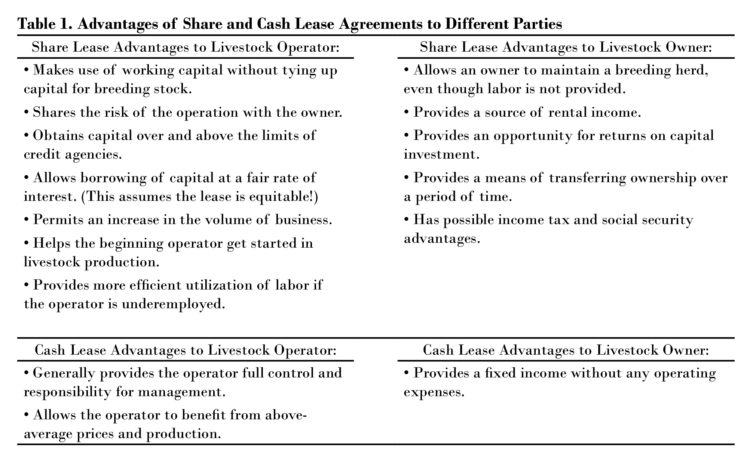
Table 1. Advantages of Share and Cash Charter Agreements to Different Parties
Tabular array one highlights some of the advantages to the livestock operator and owner of the different types of leases. Taxation considerations may likewise play a function. If the cow owner leases the cows and receives a base greenbacks rate, he or she will non be subject area to self-employment tax on that income. All the same, a cow owner who shares a portion of the production gamble volition be bailiwick to cocky-employment tax on the income received. Production gamble occurs if the owner'due south returns are a portion of the calf crop or if the owner shares a function in the direction of the cow herd. The IRS defines the management function as cloth participation and considers the cow owner to have "materially participated" if:
- The producer does whatsoever three of the post-obit activities:
- Inspects production activities (east.g., calving or feeding). Inspecting holding or improvements does non count.
- Consults with the operator nearly product of the moo-cow enterprise.
- Furnishes at to the lowest degree half (possibly less nether some circumstances) of the tools, equipment, and livestock used in the enterprise.
- Shares at least half (mayhap less under some circumstances) of the product expenses.
- The cow possessor regularly and frequently makes decisions that significantly affect the success of the farm functioning.
- The cow owner works at least 100 hours spread over five or more than weeks on activities connected to the moo-cow enterprise.
- Fifty-fifty if the cow possessor does not run across 1, two, or 3, when considered together, his or her activities may be enough for a ruling of material participation.
Considering material participation is somewhat difficult to define, the cow possessor should consult with a tax advisor if tax consequences are important for their state of affairs.
Developing Equitable Share Arrangements
Generally, the percent of profits each political party receives is based on his/her contributions to the enterprise. If the income is divided in a way that does non friction match each party's contribution to the enterprise, for instance, in a generational transfer of assets, information technology is essential that the owner and operator agree upon the terms. Because of the differences in individual farms and items furnished, the contributions in these arrangements may appear like when, in reality, they may vary a great deal. Some of the differences may include one or more of the following:
- Quality of cattle furnished. A party who furnishes $iii,000 cows contributes twice as much per moo-cow every bit i who furnishes $1,500 cows. Selling a 6-month-quondam bull calf for $2,000 contributes much more to the receipts than selling a steer for $ane,000.
- Labor. A political party who furnishes the labor for growing all the feed and providing the temporary pasture furnishes much more than one who merely feeds protein supplements to a cowherd. This can be accounted for by valuing contributed raised feed at market value. The labor requirements on timber pasture are college than open pasture.
- Pasture.The value per acre of pasture varies widely. What is important is the pasture cost per cow (which too tin vary).
- Machinery and equipment.The value of
the mechanism and equipment depends on the acres of hay and pasture produced, the amount of roughage harvested and transported, and the quality of treatment facilities contributed. As with feed, if hay is valued at market place price, it presumably covers cost of production, including machinery and equipment costs also as labor and management. Machinery costs for feeding cattle can besides vary considerably based upon blazon of feed, number of cows fed with equipment, and historic period/quality (i.east., value) of equipment.
Some product expenses, such every bit veterinary intendance and drugs, may be shared. Considering these costs affect cash menses and profitability analyses, they should still exist considered in the overall analysis of enterprise profitability (even though they do not impact the relative contributions of either party when shared in the same proportion every bit income).
The leasing agreement should be evaluated occasionally to assure an equitable arrangement over time. Fluctuating prices tin cause the proportion of contributions to shift. This could exist caused by changes in interest rates, feed costs, value of convenance stock, or labor and management costs.
An infinite number of possible arrangements for sharing the income generated from the contributions of livestock, state, and the other resources are possible. Therefore, it is important that both parties catalog their contributions and the expected values associated with those contributions.
Determining Costs to be Included
Actual subcontract records are an splendid place to start when determining the basic input items and costs that should be considered when developing a beef-cow lease. Standard upkeep worksheets (Worksheet ane) or computer programs can be used to aid place relevant costs and organize the costs for the required calculations. Many state Extension services offering budgets that may serve every bit a resources (come across http://www.agrisk.umn.edu/Budgets/ for links to many state sites). Standardized Operation Analyses summaries offer benchmarks for production equally well, particularly representing the southern Plains states (http://agrisk.tamu.edu/agrisk/beef_cow_calf/index.php). These are especially helpful when working out a charter agreement for the first time.
Cow herd costs tin can be calculated either for the whole herd or on a per moo-cow basis. Total herd figures are sometimes easier to obtain from farm records, only the parties must exist sure cost items are based on the aforementioned number of cows every bit will exist in the lease. For this reason, it is often recommended that costs be calculated on a per moo-cow unit of measurement basis. A moo-cow unit is the cow, her dogie, her share of the bull, and her share of a replacement heifer when replacements are raised within the lease. For example, if there are 100 cows in the herd and both the owner and operator concord that xv heifers demand to be retained each year, then the development costs for the heifers should exist entered into the cow unit-price budget, where the per-heifer cost is multiplied by 15% (i.e., fifteen heifers divided by 100 cows). Likewise, the costs associated with bull buying and care should be adjusted by the bull-to-moo-cow ratio.
Estimates of annual fixed costs for assets such as breeding stock, buildings, machinery and equipment can be approximated using the following steps:
Average investment = (original price + salvage value) ÷ two
Almanac depreciation = (original cost – salvage value) ÷ years of useful life
Annual interest = average investment × interest rate
Annual insurance = average investment × insurance rate
Annual taxes = average investment × personal property tax charge per unit.
Annotation that depreciation is not based on tax depreciation as tax laws alter over time and often permit complete "expensing" of items. Used machinery or equipment would have a shorter useful life than new items. In some cases it may be more than advisable to use a replacement cost or current market value as opposed to original toll in the above formulas. What is of import is that the useful life is consistent with the value used. For example, the useful life of a new building will be much longer than one associated with an older building.
A short explanation of each cost item listed in Worksheet 1 may help in arriving at an equitable arrangement.
Livestock Ownership
Interest on the boilerplate value of cows represents the investment contribution of the owner. The interest charge per unit used should be betwixt the rate that could be earned if money were invested in other alternatives (opportunity cost) and the electric current rate for borrowed capital.
Depreciation on cows is a contribution of the possessor if he/she is responsible for purchasing or raising the replacements outside of the lease. Full depreciation is the difference between the market place value of the cow when she is placed in the herd and her salvage or cull value when she is removed from the herd. To arrive at the annual depreciation, total depreciation is divided by the number of years the cow is expected to remain in the herd. When replacement heifers are raised within the charter, these costs are included in the production inputs so depreciation is not a factor.
Involvement and depreciation on bulls are computed in the same way as for cows. The annual cost of the bull is divided past the number of cows served each yr to determine the cost to exist allocated confronting each moo-cow. Schedule A tin can be used to guess the depreciation and average investment for both cows and bulls.
Taxes on livestock are the amount of personal property tax (if any) on the cows and bulls.
Cow insurance or death loss could exist shared if, for instance, the operator guarantees a maximum death loss. The cost of insuring the moo-cow is typically used, but death loss can
exist substituted when the contributing party "self insures" (i.e., does not purchase insurance). Do non include both if death loss is reimbursed by insurance. Cow insurance or death loss is commonly computed at 0.5 to 1.0 percent of the boilerplate value of the cow.
Machinery, Equipment and Buildings Used in the Livestock Enterprise
Involvement and depreciation on buildings, machinery and equipment used in the livestock operation is a contribution of the political party who owns the property. One alternative for valuing the contribution is to utilize the rental rate (for example, cost per hour to hire a tractor), which may work well where markets are established and rental rate information is available. In other cases, information technology may be appropriate or necessary to calculate almanac interest, economic depreciation, interest and taxes on the contributed assets. Assigning a proportion of the value of an asset to the livestock enterprise is also required, if for example, a tractor or trailer is used for other purposes in addition to the cow enterprise.
The value of buildings, machinery and equipment used in the beef-moo-cow enterprise varies from operation to operation.
Schedules B and C can be used to estimate the machinery, equipment and building investment used in livestock production. Livestock machinery and equipment would include tractors, wagons, trucks, trailers, loaders, manure spreaders, large bale spears, hay feeders, feed bunks, mineral feeders, and handling facilities used in feeding, handling, and observing livestock. Livestock machinery and equipment does not include hay or silage harvesting equipment if ingather/hay contributions are valued using market prices.
Taxes and insurance on buildings and equipment are the costs for taxes and insurance incurred against property used for livestock during the year. These costs typically range from i to 2 percent of the current value of buildings and equipment.
Repairs on buildings and equipment are the costs of maintaining buildings, equipment, and fences used for livestock production. Repairs typically boilerplate 2.5 to iv percent of new costs on an annual basis.
Pasture
The land charge for pasture can be calculated two ways: a) landowner'due south ownership costs or b) cash rental value. Ownership costs include a render on country investment plus real estate taxes. The cost of fencing, gates and watering systems may be included in the land investment when existence used in
the livestock enterprise. A fair marketplace value for agricultural purposes is placed on the land and multiplied by the long-range rate of return to land (typically 1 to 4 percent)
to summate the almanac contribution. Real estate taxes are bodily costs; however, they may be accounted for in the charge per unit of return and thus it is important to non double count them. The rental value for the landowner is the corporeality for which the holding could be rented to someone else. If the land is being rented by the political party providing it, then the contribution is the bodily cost of rent. Rental rates may exist quicker and easier to apply if in that location is an established marketplace for pasture in the area. Schedule D can be used to calculate the number of acres of pasture needed per cow unit. For more than data on pasture leases, see NCFMEC-03, "Pasture Rental Arrangements for Your Farm".
Feed and Other Expenses
Software tools may be useful in determining appropriate combinations
of forage, hay and feed to meet the cow'south nutritional needs under different pasture situations and feed/hay pricing environments (for instance, see http://beefextension.com/files/Cowculator%202%200.xls). Hay, silage, and other raised feed should be valued at long-run market prices when estimating contributions for a multiple year charter. However, if the charter will only be for one yr then information technology may be more than advisable to use current marketplace prices. Marketplace value is the price that could exist received if the product is sold instead of used on the farm. Toll of product can exist used in a whole farm charter agreement; however, market values are generally used because they are simpler to calculate. It is recommended that long-run market values be used for all raised feed for the beefiness cow herd share agreement. Notation: If hay, silage, and/ or grain raised under a split crop-share charter arrangement is fed, the landowner needs to receive credit for his or her share. If both parties contribute to the cost of producing feed, each political party should receive credit for his or her contribution. For example, one party may furnish land for hay product and the other political party may furnish machinery and labor. Nonetheless, as stated previously, the moo-cow herd lease arrangement will be much more straightforward with fewer potential complications if other leased avails (e.thou., pasture, hay ground, crop country) are handled with a separate agreement.
Protein and mineral supplements should be valued at price. It is by and large recommended that protein and mineral exist furnished past the same party providing the hay and provender and so in that location will be no disharmonize concerning winter rations.
Veterinary and drug expenses may be contributed by either party, or they may
be shared the same as the income is shared. When shared the same every bit income, they are not factored into calculations for determining the equitable shares. (Encounter section on shared and unexpected expenses.)
Fuel and oil costs would be for feeding, hauling, and observing livestock.
Truck expenses, including repairs, license, insurance, interest, and depreciation, should be prorated to the cow herd if the truck is not included in the livestock machinery and equipment. Hired trucking and marketing generally are shared, because they are frequently deducted from sales.
Utilities and miscellaneous costs should include water charges, electricity, phone, postage stamp, dues, and registration fees that are chargeable to the moo-cow herd.
Labor is a contribution of the party providing it. If labor is hired, the expense is the actual price to the party who pays for it. If labor is furnished by one or both parties, then labor should exist valued at the going charge per unit as though information technology had been hired. Labor required per cow per year will vary with the size of the herd. Large herds will require around six hours per cow per yr while per cow requirements for smaller herds may exist substantially higher (see Figure i). An additional assart would be required if replacements are raised within the lease rather than purchased.
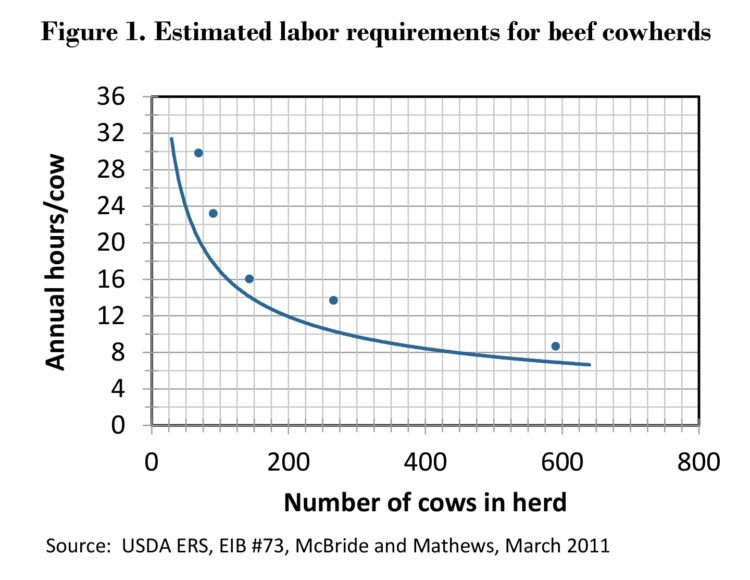
Figure one. Estimated labor requirements for beef cowherds
Management of the cow herd typically will exist the responsibleness of both parties. The possessor of the cows should decide, in consultation with the operator, which
cows to cull and which heifers to go along for replacements. The owner, forth with the operator, should decide on bulls to use that will maintain or improve the herd quality.
The operator should be responsible for the twenty-four hours-to-day decisions involved in managing
the moo-cow herd to produce maximum returns. Management tin can be valued at 0.five to ane.0 percent of capital letter managed or v to x percentage of value of annual production. Schedule E tin can be used to calculate a management accuse. Because management is difficult to define, and because both parties provide direction, this contribution is oftentimes excluded from the calculations in determining equitable shares.
Shared and Unexpected Expenses
Sharing the cost of production-increasing inputs in the aforementioned pct as the value
of production encourages the parties to use the optimal corporeality of the input so every bit to maximize net returns to the total business operation. Examples of production increasing expenses include, merely are not limited to, antibiotics, implants, and pitter-patter feed. Fifty-fifty though shared expenses exercise not bear upon relative contributions, they should exist calculated for a total price judge that can
be used for greenbacks menstruum and profitability analysis. These costs tin be entered on Worksheet 1.
Unexpected expenses such as additional feed during a blizzard or drought, catastrophic wellness problems, and other irregular items should be shared, because they are periodic and difficult
to predict. If shared, unexpected expenses do not alter the pct contribution of either party when they occur.
Full Costs
Total costs reverberate the combined contributions of both parties. The number may lead to business by lease parties about the profitability of the cow herd operation, which is a risk each party assumes. If gross returns per cow exceed total costs per cow, each party will get total value for all costs plus a "profit." If gross returns are less than total costs, then each political party will non receive full value for their contribution. However, this does not necessarily hateful that each party does not do good from the operation. Livestock owners may realize benefits such as capital letter gain advantages and pride of ownership. Livestock operators may be able to utilise hard-to-market feed and off-flavour labor.
Determining Contributions of Each Party and Percent Contributed
After the almanac contribution for all product inputs is determined (Worksheet 1, total column), costs are allocated to the political party who contributes each particular input (owner and operator columns). If a sure input factor is provided by both parties, it is divided betwixt them. Worksheet one tin be expanded to include more than two parties if needed. As noted earlier, the value of homegrown grains and forages raised on land owned past 1 political party and farmed by the other party are prorated based on the crop-share agreement. When the allocations are completed, the inputs are added to determine the total contribution by each party.
To make up one's mind the pct contributed by each party, split the amount contributed for each individual party by the total contribution of all parties. Expenses to be shared should be shared in these aforementioned percentages.
Determining Income
Value of product is shared in the same proportion as costs are contributed. Value
of production may or may not be the same as sales. When replacement heifers or cows are purchased or provided from other sources outside the charter, value of production equals full dogie sales. Dogie sales are shared based on the percent contribution. Even so, when replacement heifers are retained and not sold, their estimated value plus calf sales equals value of production. Full value of product is shared based on the percent contribution.
The method of providing replacement cows or heifers has a major affect on items that are considered as contributions and on how greenbacks income is shared. In all cases, cull balderdash income would get to the political party that provided the bull(due south). When replacement females are provided by the owner and not raised as part of the lease, depreciation and death loss are part of the owner's contribution; when replacements are raised every bit part of the lease, depreciation and expiry loss are non
office of the owner's contributions, leading to a smaller share of contributions unless other adjustments are made. Tabular array 2 highlights several means of computing contributions and sharing income for alternative ways of how replacements are handled in the lease (too described in more detail in notes that follow).
- Replacements are purchased by the possessor. All calves are sold and proceeds are split based on contributions. Choose cow sales go to the owner and the possessor provides replacements. This is the simplest and most articulate-cutting method.
- Replacements are kept but raised in a split performance. A marketplace value is placed on the replacement heifers every bit if they were sold. When the remaining calves are sold, 1) the operator and owner share all calf sales, and the owner purchases the operator's share of the replacement heifers; or 2) the operator receives a higher percentage of cash sales because the cow owner receives the replacement heifers as a share of income. In either case, the operator's income equals operator percentage share times the sum
of cash sales and the value of replacement heifers. The cow owner would receive all cull cow income, would own the replacement heifers, and be responsible for the cost of growing them to maturity. - Share value of production of calves (dogie sales plus value of replacement heifers). This method is the same as method 2 except the cow owner's share of contribution and receipts would be smaller. Owner's cost would exist lower because the cost of growing the replacement heifers is included in contributions. The cow owner would ain the replacement heifers and would receive all cull moo-cow sales.
- Share all sales. All calf and cull cow sales would exist shared based on percent contribution. Cow sales are substituted for the value of replacement heifers. This method is simpler and works well when cull cows are well-nigh equal in value to heifers and the size of the herd stays the aforementioned. The possessor has less capital gain sales and more ordinary income for tax purposes.
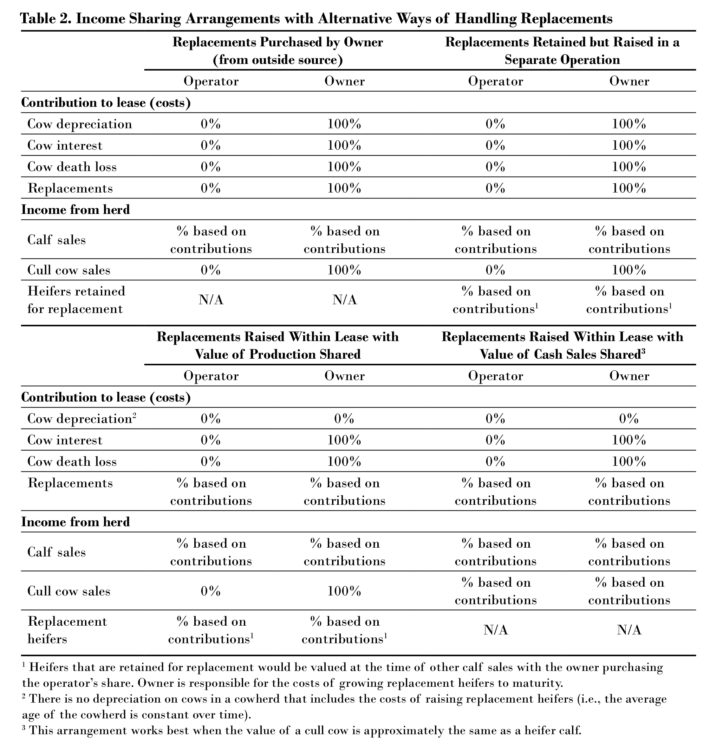
Table 2. Income Sharing Arrangements with Alternative Means of Treatment Replacements
A beef-moo-cow share-leasing organization that is fair, equitable, and uncomplicated tin
be very satisfactory for all parties. The worksheets in this bulletin and supporting schedules can exist used to determine the value of contributions and percentages for sharing income. A companion figurer spreadsheet (KSU-BeefCowLease.xls) is also available that tin can be used to approximate the equitable share rent and cash rents. The Excel spreadsheet is bachelor at world wide web.AgManager.info/Tools/ default.asp#LIVESTOCK or the AgLease101. org website. (A similar tool, File C2-36, is available on the Ag Decision Maker website)
Cash Leasing Beef Cows
Nether sure conditions, renting cows for cash might be preferable to a share arrangement. For case, a farmer/rancher contemplating retirement might be interested in renting out his or her cows. A young
farmer, limited on capital, might exist interested in renting extra cows to employ pasture. In either case, neither party may exist interested in renting for long periods of time. The aforementioned data used to determine the value of contributions nether a share organization is used to determine cash hire desired and an ability to pay rent. Bounty is expected for a render on investment, depreciation, taxes, and death losses. The prospective renter should estimate the returns from a cow (or herd) to make up one's mind how much hire could be paid.
Determining the Greenbacks Rental Rate
Greenbacks rental rates tin can be determined iii ways:
- Livestock ownership costs. Ownership costs are the same equally discussed in the share lease section. They are depreciation, involvement on investment, insurance or expiry loss, and personal property taxes, if any. Section 2 of Worksheet 2 can be used to calculate ownership costs.
- Livestock owner net share rent. Net share hire for the livestock possessor is the owner's share of value of production less shared expenses and a take a chance adjustment. The cyberspace share rent is adjusted for hazard because the owner no longer has any production or price hazard (Worksheet two, Section two).
- Operator'due south cyberspace return to livestock. Operator's net return to livestock is the value of product minus the operator's production expenses. The internet return to livestock represents the nigh an operator could pay given the estimated costs. Worksheet ii, Section iii, can be used to calculate the operator's costs and net render to livestock.
Evaluation of the three rates can provide an opportunity for discussion and negotiation to determine an adequate cash rental charge per unit.
Cash rental rates need to be reevaluated on a regular basis. Cattle prices can change significantly from year to year, irresolute the render to fixed avails. Because risk is non shared between owner and operator, the lease may demand to be re-evaluated or changed to a share arrangement.
Leasing Bulls
Another way for the cow owner to reduce expenses is to charter, rather than own, a bull. The producer must compare the costs and benefits of leasing a bull with owning a bull. Leasing eliminates the capital expenditure of purchasing a balderdash. The cost of purchasing a balderdash depends on the cattle market place and quality of the bull. Most bull owners in the leasing business organisation charge $700 or more than per convenance season.
A leased balderdash is generally but kept during the breeding season, then operating costs are reduced. For case, the toll of feeding a bull is estimated at $350 per year. The costs
of veterinarian and medicine, marketing, and death loss (1 pct) approximate $35. Labor is estimated at virtually $45 per year, resulting in total cash costs of $430 per balderdash per year.
Some other cost of owning a bull is depreciation and interest. Table 3 gives an example of the costs of depreciation and interest on average investment for a bull depreciated for three and four years using a v% interest charge per unit and $two,000 relieve value with unlike buy prices.
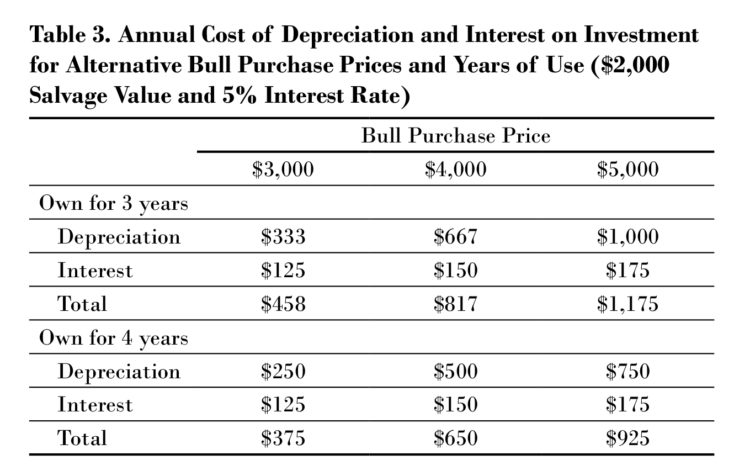
Table 3. Annual Price of Depreciation and Interest on Investment for Alternative Balderdash Purchase Prices and Years of Utilise ($2,000 Relieve Value and 5% Interest Rate)
The cow possessor must too consider how leasing a bull could affect the health of their herd. Leasing virgin bulls is ideal to ensure that a venereal illness such as vibriosis or trichomoniasis is not introduced into the herd. This may not be an selection, and then owners should consult a veterinary to ensure that leased bulls are good for you.
If they have adequate capital and a large cowherd over which to spread operating costs, producers may want to ain one or more bulls to ensure they have a quality bull for use each season. There is also the benefit of the salve value when the bull is sold.
Putting the Agreement in Writing
A written agreement offers a number of advantages:
- It encourages a detailed argument of the agreement that assures a improve understanding past both parties.
- It serves as a reminder of the terms originally agreed upon.
- Information technology provides a valuable guide for the heirs if either the operator or livestock owner dies. The agreement should be carefully reviewed each twelvemonth to ensure the terms of the agreement are all the same applicable and desirable.
- It serves equally documentation for revenue enhancement purposes.
Every lease should include certain items. These are the names of the parties involved, an accurate clarification of the property existence rented, the livestock lease terms described earlier and the signatures of the parties. Absent a statutory or constitutional limitation, the elapsing of the charter can exist any length of time agreed upon by the parties. Most leases are for at least 1 full year. Operators sometimes request leases for more than i year, particularly if they must invest more capital in equipment or improvements needed.
The lease also needs to clearly specify ownership of the cattle. Sometimes, a lessee may accept a loan secured by his or her cattle. However, the definitions of "cattle" in the loan documents may exist and so broad every bit to include all cattle possessed by the rancher. As a result, the owner of leased cattle runs the risk of his or her cattle being seized and sold if the lessee defaults on his or her loan obligations. To minimize this take chances, the lease certificate needs to be very clear that (one) championship to the leased cattle remains with the lessor, (2) the lessee will accept whatever steps are necessary to prevent the leased cattle from becoming "collateral" for any of the lessee'south debts, (3) the lessee will reimburse the lessor in the event of any seizure and sale of the lessor's cattle, and (4) the lessee volition not brand, mark, or identify the leased cattle in any way that could cause them to be mistaken for the lessee's own cattle. The lessor should as well accept care to brand, tag, or otherwise identify the cattle with his or her ain marks before turning over possession of the cattle to minimize these risks.
In full general, most transactions involving real estate require a contract in writing to be enforceable. In nearly states, oral leases for not more than a year are enforceable. Because specific legal terms surrounding leasing vary from state to state, livestock owners and operators are encouraged to check with their local Extension service or a knowledgeable lawyer as to the specific laws for their land. As a practical matter, though, it is always a good thought to put the understanding in writing, regardless of its duration. Putting an agreement in writing helps both parties understand their rights and duties and can help resolve many disagreements before they even starting time.
Livestock owners, equally well as operators, should enter long-term leases only after very careful consideration — a lease contract "marries" parties to undesirable and desirable provisions akin. Often, it is better to include a provision for purchase-out terms or compensation for unexhausted improvements fabricated by one political party rather than to take a long-term lease that fixes terms for an extended fourth dimension menstruation. One of the functions of a written charter is to anticipate possible developments and to land how to handle such issues if they actually do develop.
Decision
A moo-cow share lease is a prime manner for a moo-cow owner and operator to pool their country and livestock resource. If the arrangement is properly laid out ahead of time, the lease tin can help each party share product adventure. The charter should be a written document and cover all costs of production as well as possible situations that could ascend during the duration of the contract. The parties entering into the organisation should clearly ascertain their expectations with respect to sharing of costs and receipts. The cow owner and operator should choose an arrangement that best matches their resources and desired returns.
Worksheets
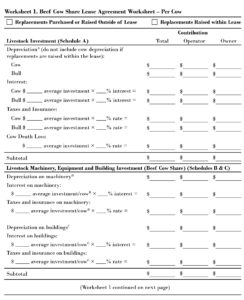
Worksheet 1 and 2
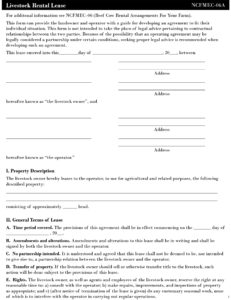
Sample Lease Course
* Originally published on Ag Lease 101 past North Primal Farm Direction Extension Commission. http://world wide web.aglease101.org.
Source: https://ag.purdue.edu/commercialag/home/resource/2013/02/beef-cow-rental-arrangements-for-your-farm/
0 Response to "Beef Cow Cash Lease Ageement Oregon"
Post a Comment